DevToolbox
A privacy-first, browser-based suite of 150+ developer utilities built with Next.js for instant, client-side execution without authentication or data storage.
Usecase
DevToolbox enables developers to quickly access encoding, formatting, security, networking, CSS, DevOps, and SEO utilities in one centralized platform without relying on multiple fragmented online tools.
Overview
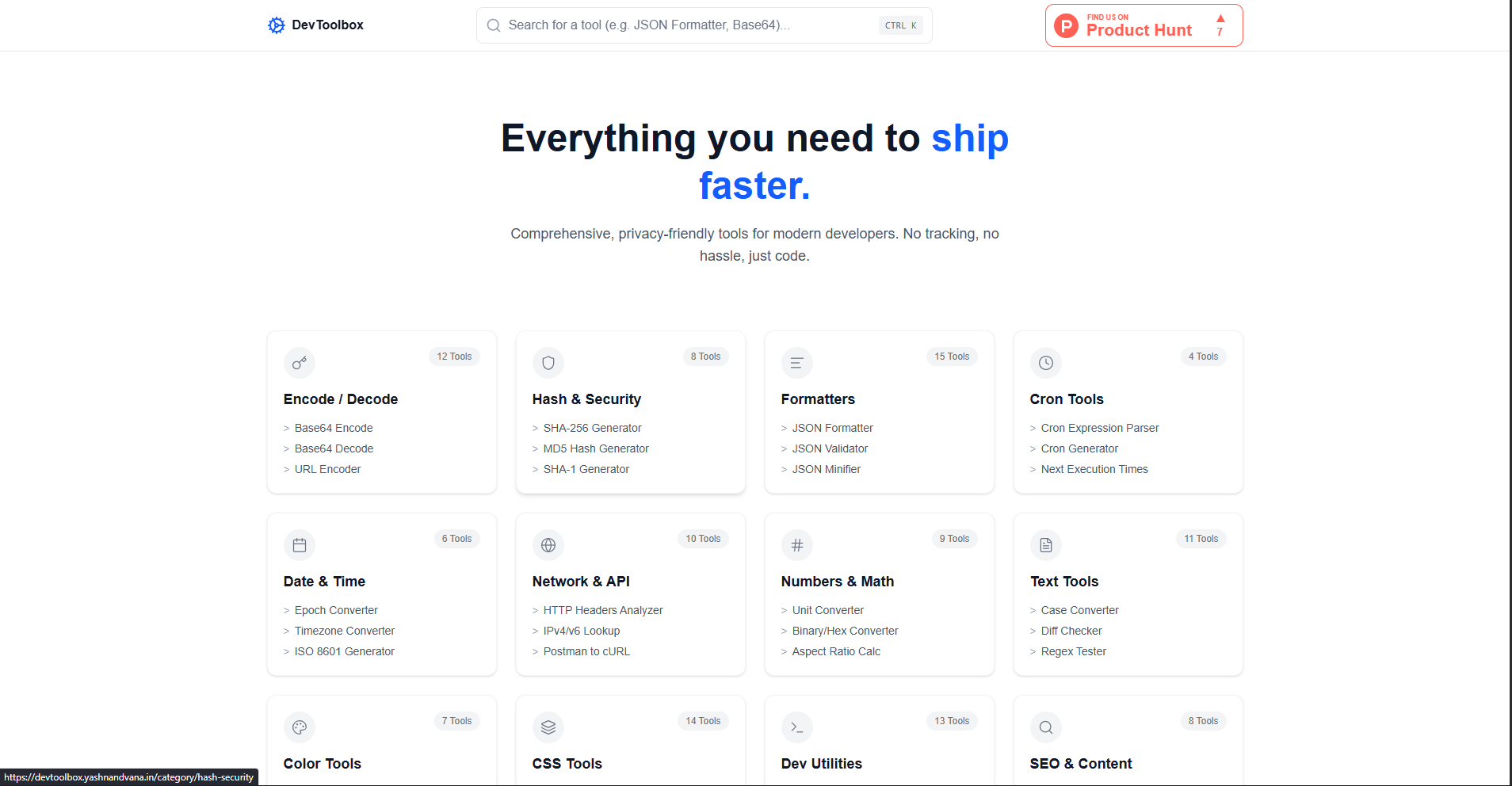
DevToolbox is a scalable multi-tool web application designed for developers who require fast, privacy-focused utilities directly in the browser. The platform organizes 150+ tools across structured categories including Encode/Decode, Hash & Security, Network & API, Date/Time, Text Processing, CSS Generators, DevOps Utilities, and SEO Tools. All computations execute client-side to eliminate backend dependencies, reduce latency, and guarantee zero data persistence.
Key Features
Tech Stack
- Next.js – Framework powering routing, component architecture, and optimized production builds.
- TailwindCSS – Utility-first CSS framework used for building a responsive and modern developer-focused UI.
- Lucide React – Icon library used to maintain consistent and lightweight UI visuals.
- JavaScript – Core language used for implementing all tool logic and browser-side processing.
- Vercel – Cloud deployment platform used for hosting and delivering optimized builds globally.
Challenges & Learnings
Managing Large-Scale Tool Organization
Structuring and categorizing 150+ tools required scalable routing and component reusability to avoid duplication and maintain performance.
Ensuring Pure Client-Side Execution
All processing logic needed to function without backend APIs, requiring careful implementation of encoding, hashing, parsing, and validation directly in the browser.
Maintaining Performance with Many Utilities
Optimizing load times and preventing unnecessary re-renders was critical due to the high number of dynamic tools and interactive components.
Outcome
DevToolbox evolved into a comprehensive developer utility platform that consolidates essential engineering tools into a single, privacy-focused interface. It demonstrates scalable frontend architecture, modular design thinking, and production-grade deployment practices.
Intereseted in building something similar?

